
A Regional Market of Scale, Stability, and Workforce Strength
The Great Falls Trade Area serves as the commercial, workforce, and service hub for a broad region of North Central Montana. Spanning multiple counties, the region brings together a population of over 235,000 residents, creating a stable and reliable market base for businesses and investment.
This is not a single-city economy—it is a regional population center that supports retail, healthcare, manufacturing, logistics, and professional services across a wide geographic footprint.
The Great Falls Development Alliances seeks foremost to focus on the 13-county Great Falls Region Trade Area.
Are you located in our trade area and interested in collaborating? Contact us today!
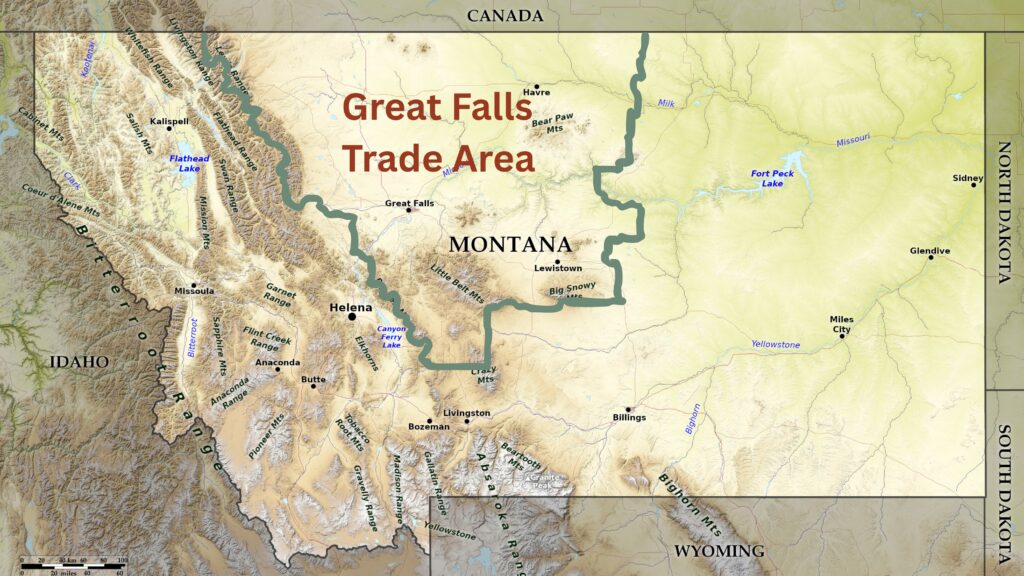
- Fergus
- Cascade
- Teton
- Pondera
- Glacier
- Toole
- Chouteau
- Blaine
- Meagher
- Judith Basin
- Liberty
- Lewis and Clark
- Hill

Questions about the Great Falls Trade Area?
Contact our team today!
Population & Regional Reach
The trade area includes communities across North Central Montana, with Great Falls functioning as the primary hub for commerce, healthcare, and employment.
- Population: 235,883
- Regional Growth: Steady, with consistent annual increases
- Population Density: Low-density region with centralized service hub
The region’s structure creates a hub-and-spoke economy, where residents from surrounding counties rely on Great Falls for goods, services, and employment—expanding the effective market reach well beyond city limits.
Workforce & Labor Force Characteristics
The region supports a large and active workforce, with strong participation and availability.
- Labor force: 113,462 individuals
- Labor force participation rate: 61.4%
- Prime-age participation (25–54): 81.6%
The workforce is supported by:
- Short average commute time (17.2 minutes)
- High workforce reliability and accessibility
- Regional draw from surrounding rural communities
This creates a dependable labor base with strong regional pull.
Education & Skills
The Great Falls Trade Area workforce offers a practical, skills-based labor pool with a mix of technical training and higher education.
- 32.2% hold a bachelor’s degree or higher
- Strong representation in:
- Skilled trades
- technical and associate-level education
- workforce-ready certifications
This mix supports industries that rely on hands-on skills, operations, and applied expertise, while still providing access to professional and technical talent.
Income & Cost of Living Advantage
The region offers a competitive cost structure for both businesses and residents.
- Median household income: $68,123
- Cost of living: Below the national average
- Median home value: $291,302
Lower costs translate to:
- Increased purchasing power
- Greater workforce retention
- Reduced operating expenses for employers
Housing & Community Profile
The Great Falls Trade Area provides a stable housing market with strong homeownership:
- 68.4% owner-occupied housing
- Balanced rental market
- Low vacancy rates
These characteristics support:
Consistent community investment
Workforce stability
Long-term residency